

People don’t just search anymore—they expect answers, and they expect them fast. That’s why Search Experience Optimization (SXO) matters more than ever. It’s not just about showing up on Google; it’s about making sure your site feels right once someone clicks.
SXO brings together smart SEO with a smooth, thoughtful user experience—so visitors don’t just land on your page, they stay, engage, and convert. Whether you’re building a brand or growing a startup, SXO helps you show up and stand out.
What is Search Experience Optimization (SXO)?
Search Experience Optimization (SXO) is the convergence of Search Engine Optimization (SEO) and User Experience (UX). Whereas SEO gets your content in front of users, SXO makes the user have a great time once they arrive at your site. It is about fulfilling user intent, serving useful content, delivering a seamless experience, and stimulating valuable interaction. SXO is all about the visitor journey from discovery to action — an efficient yet enjoyable search experience.
Benefits of SXO
- Turns user interest into meaningful actions
- Makes users find what they need fast and effectively
- Grows time on site and builds brand trust
- Decreases bounce rates and enhances on-site engagement measures
- Improves search engine rankings based on positive user signals
- Makes ROI from content already available more effective
- Provides improved mobile experiences based on user behavior
- Leads to increased engagement, greater trust, and higher conversions
What is the Difference Between SEO and SXO
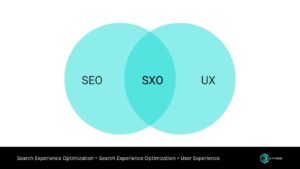
SEO is all about visibility — keyword optimization, metadata, and links to become well-positioned in search engines. SXO extends this by optimizing the user’s overall journey. SEO gets users in; SXO makes them stay. SEO solves “Can users find this page? “, whereas SXO poses, “Does this page deliver what they require?”.
Together, they make your site not only findable but also useful, valuable, and actionable — the ideal mix of reach and relevance.
7 SXO Implementation Strategies
1. Align Content with Search Intent
Each page must clearly answer what the user is looking for. Recognize the intent behind keywords — informational, navigational, or transactional — and create content that satisfies those. Present the most important information first, organize it effectively, and utilize clear subheadings.
This not only enhances your opportunity to rank higher but also provides users with instant clarity, generating the potential for longer site visits and satisfied goals.
2. Optimize for Mobile-First Experience
Thanks to mobile-first indexing, Google indexes your site based on its mobile version. That implies that your design should be responsive, load quickly on smaller devices, and present tap-friendly navigation. Keep things simple in the layout, minimize clutter, and make fonts legible.
A mobile-optimized experience removes friction for most users who access their websites on smartphones, making them more likely to remain, browse, and convert without the technical hurdle.
3. Enhance Core Web Vitals and Performance
Page speed is crucial for both user experience and search engine ranking. Core Web Vitals quantify load time, visual stability, and responsiveness — all of which contribute to user satisfaction and overall site performance optimization.
To optimize performance, compress images, minimize unnecessary scripts, utilize efficient hosting, and enable browser caching. A fast and stable website not only complies with Google’s requirements but also avoids user frustration, retains users’ attention, and enhances your site’s credibility.
4. Organize Content for Scannability
People scan before they read. Use headings, bullet points, brief paragraphs, and bolded key phrases to organize your content. Make it simple to get answers quickly, particularly for mobile device users.
Scannable content maximizes dwell time and engagement by allowing readers to quickly locate the most critical information. It also enhances the likelihood of being selected for featured snippets and voice search results.
5. Make Use of Clear and Convincing CTAs
Calls to action (CTAs) prompt users to take their next step — whether signing up, making a purchase, or learning more. Use clear, action-driven language and place CTAs where they naturally align with user interest.
Make them visually distinct without interfering. A good CTA engages passive readers and turns them into active participants, making your site not only informative but also goal-centric and conversion-focused.
6. Improve Site Navigation and Organisation
An organized and uncluttered design facilitates an effortless transition between pages. Utilize breadcrumb paths, coherent menu hierarchies, and intrasite linking to direct their path. Avoid overwhelming users with too many choices or overly complex designs.
Effective navigation eliminates bounces and enhances crawlability for search engines — two key assets that benefit both SEO and user experience simultaneously.
7. Add Structured Data and Schema Markup
Structured data also helps search engines better comprehend your content and display it as rich results. Implement a schema for articles, FAQs, products, and reviews to optimize the way your pages are displayed in search results.
This enhances visibility via features such as review stars, breadcrumbs, and snippet highlights. Amplified search listings drive more qualified traffic and higher click-through rates — an SEO and SXO win.
Measuring and Improving SXO Performance
You can’t optimize what you don’t measure. SXO success is monitored through a combination of SEO metrics and behavior analytics. Utilize tools such as Google Analytics, Search Console, and heatmaps to track bounce rates, scroll depth, time on page, and conversion paths.
Regularly check Core Web Vitals to ensure your website’s technical health. Perform A/B testing on CTAs and layouts to optimize performance. Continuous feedback loops ensure that your site not only ranks, but also converts.
Summary
Search Experience Optimization is the future of digital strategy. It guarantees your site not just gets discovered, but also acts as a high-converting, user-first platform. SXO keeps companies ahead of the game by focusing on what truly matters: guiding users on their journey from curiosity to conversion. When SEO and UX work in perfect harmony, you build a digital space where both Google and your users are happy — and that’s where true growth occurs.
Master Search Experience Optimization: Improve SEO and User Engagement Now
As online competition intensifies, relying solely on keyword rankings is no longer sufficient. Your success hinges on providing a streamlined, satisfying search experience — and that’s exactly what SXO is all about. At Edifybind, we pair expert SEO knowledge with user-centric design to boost search experiences that rank, engage, and convert.
If you’re ready to take your website’s performance to the next level and make every visit meaningful, Edifybind can help you master SXO and stand out in search.
Frequently Asked Questions
- Is SXO superior to SEO?
SXO encompasses SEO but takes it a step beyond by augmenting the user experience once they reach your site. It’s not a replacement, but an evolution.
- Will SXO enhance my site’s rankings?
Yes. Google takes user behavior signals such as bounce rate and engagement — areas that SXO specifically improves — into account when calculating rankings.
- Do I require technical proficiency to execute SXO?
While you have to have technical know-how, a lot of SXO enhancements, such as layout, pace, and content design, can be managed using proper tools or by collaborating with professionals such as Edifybind.
- How frequently should I assess my SXO strategy?
Undefined. It is perfect to do regular checks every quarter, but track key performance metrics weekly so you can detect any issues immediately and adjust accordingly.