
Search patterns have evolved. Rather than entering keywords such as “best digital agency in Chennai,” individuals currently query, “Who’s the nearest best agency?” Courtesy of voice assistants and AI capabilities, search is more conversational, and that is where AEO and GEO enter the fray.
Enter AEO (Answer Engine Optimization) and GEO (Generative Engine Optimization)—the next step beyond traditional SEO. In this blog, we’ll break down what they mean, how they work, and why combining all three is key to staying visible in today’s AI-driven search world.
What is SEO?
Search Engine Optimization (SEO) is the practice of improving your website’s visibility in search engines, such as Google and Bing. It’s making search engines aware of your content so they position it higher for related searches. SEO is still a vital foundation of digital marketing and is centered around:
Targeting keywords that align with user intent
- Enhancing technical aspects such as page speed and mobile-friendliness
- Establishing authority through backlinks
- Producing in-depth, valuable content
When executed properly, SEO enables your site to rank at the top of search results—driving long-term organic traffic and establishing credibility.
Online Search Behavior is Changing
We’re all looking for things differently now. We talk, not text. We engage with Siri, Alexa, Gemini, and ChatGPT, rather than relying solely on Google. This conversational manner is more human—and it requires content that is differently constructed. Consumers are seeking direct answers, abstract insights, and rapid resolutions, often without needing a single click.
This shift in behavior gave rise to AEO and GEO, two new forms of optimization marketers can’t afford to overlook.
Role of SEO in Digital Marketing
SEO remains a foundation for any successful online strategy. SEO enables companies to rank organically, save on ad spend in the long run, and establish a solid online presence. It also feeds other channels such as content marketing, social media, and paid advertising. Without a strong SEO foundation, even high-quality content can become invisible to search engines.
Additionally, SEO enhances site architecture, navigation, and user experience—factors that collectively drive performance across the board.
How Does SEO Work?
SEO operates through matching your content with search algorithms. The algorithms determine relevance, authority, structure, and user experience. To get noticed, brands must:
Carry out keyword research to know what people are looking for
- Optimize meta titles, descriptions, and headers to enable content to be crawled effectively.
- Create quality backlinks from authoritative sites.
- Ensure technical performance, including speed and responsive design.
- Create content that addresses user problems.
When all these ingredients are combined, your site is more visible, trustworthy, and valuable to users.
What is AEO?
AEO (Answer Engine Optimization) refers to the process of getting your content ready to be captured by voice assistants and direct answer sites. People now expect responses within seconds, particularly when using devices like Alexa or Google Assistant.
How To Implement AEO?
To be successful with AEO, your content must be designed to provide quick and clear answers to specific questions. This means: Developing FAQ sections that respond to frequent questions directly
Including structured data such as schema markup to enable machines to comprehend content
- Writing concise, authoritative answers—preferably within 40–60 words
- Opting for position zero—the featured snippet on search engines
- AEO is critical if your audience is searching using mobile devices, voice assistants, or smart assistants.
What is GEO?
Generative Engine Optimization (GEO) is the latest development. It’s all about training AI models, such as ChatGPT, Gemini, and Grok, to read, learn from, and reuse your content. When a user poses a question to a generative AI, your content might be the source that informs the answer.
How to Do Generative Engine Optimization
GEO is not about keywords—it’s natural, human speech. You need to write content that can be understood by AI models in context and with a clear flow. Here’s how:
- Write conversationally, as if you’re speaking to a reader
- Use semantically rich language and real-life examples.
- Offer depth, insights, and well-structured explanations
- Don’t produce fluff or robotic writing styles.
- Utilize tools such as Jasper, NeuronWriter, and Surfer SEO to optimize for LLM.
With GEO, you’re not just showing up in search—you’re part of the AI-generated conversation.
What Do SEO, AEO & GEO Have in Common?
At their core, all three optimization types serve the same purpose: helping users find relevant, accurate, and helpful information. Whether it’s through a search engine, voice assistant, or generative AI, your content must:
- Match user intent
- Provide value quickly and clearly.
- It is easy for machines to understand
- This common objective makes them complementary, not competitive.
How SEO, AEO, and GEO Differ
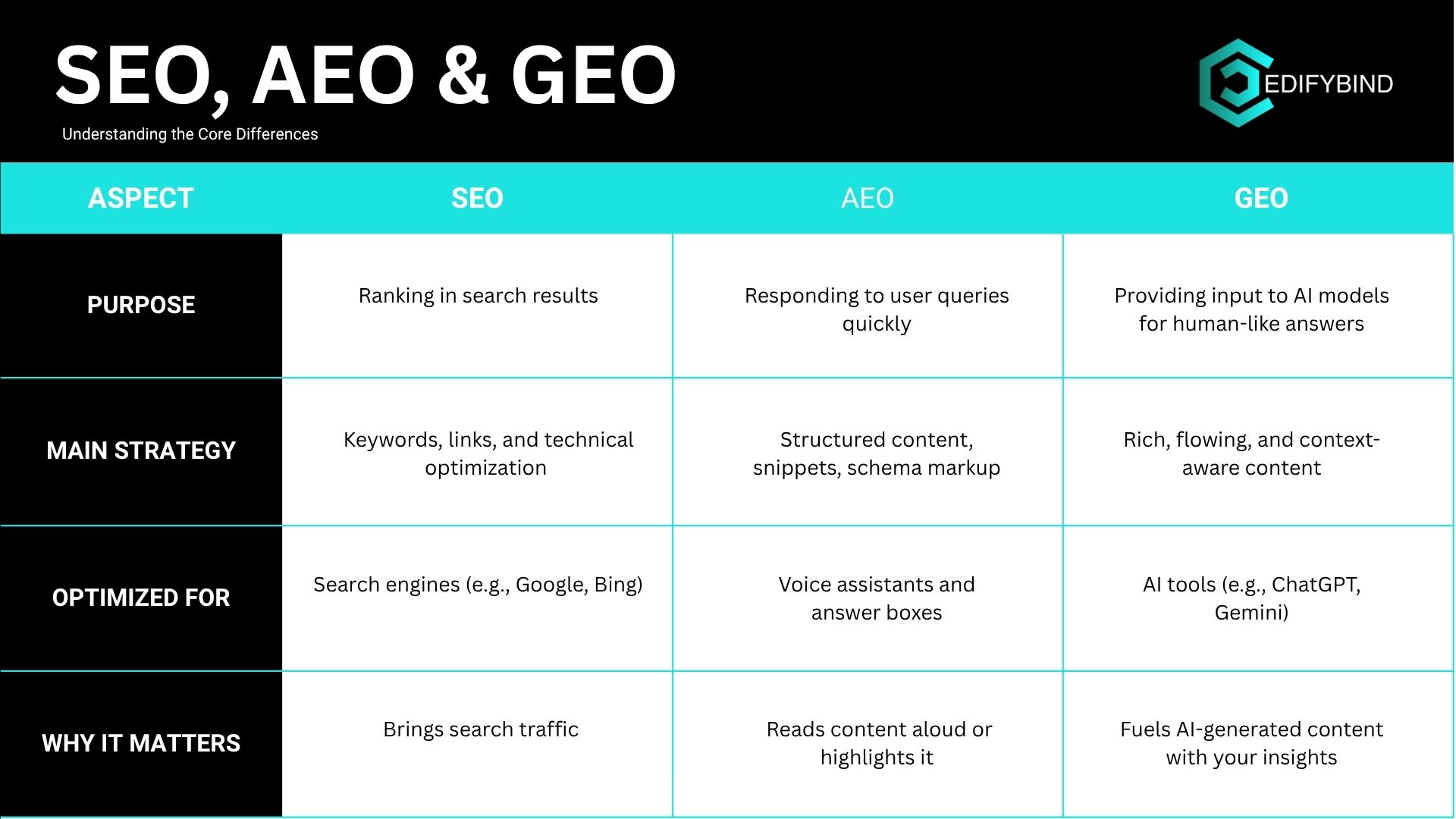
Although they are all working toward the same things, SEO, AEO, and GEO each address different audiences, purposes, and platforms.
Purpose:
- SEO is concerned with ranking in search results.
- AEO is committed to responding to user queries in a timely manner.
- GEO is concerned with providing input to AI models that produce human-like answers.
Main Strategy:
- SEO relies on keywords, links, and technical optimization.
- AEO is concerned with structured content, snippets, and schema markup.
- GEO demands rich, flowing, and context-aware content.
Who You’re Optimizing For:
- SEO: Search engines like Google or Bing.
- AEO: Voice assistants and answer boxes.
- GEO: AI tools like Gemini and ChatGPT.
Content Style:
- SEO prefers long-form, keyword-optimized blogs.
- AEO works best with short, snappy answers.
- GEO thrives on depth, natural tone, and semantic richness.
Popular Tools Used:
- SEO: Ahrefs, SEMrush, Moz
- AEO: Frase, AlsoAsked, AnswerThePublic
- GEO: Jasper, Surfer SEO, NeuronWriter
Why It Matters:
- SEO brings search traffic.
- AEO reads your content aloud or highlights it for you.
- GEO leverages your insights to create AI-generated content.
Wrap Up:
As search moves from keywords to conversations, simply optimizing for SEO won’t suffice. Adopting AEO and GEO keeps your content visible across voice, search, and AI platforms. At Edifybind, we help businesses create content that ranks, responds to, and resonates with both people and machines.
Future-proof your visibility? Let’s build smarter content.
www.edifybind.com | info@edifybind.com | +91-8148742240